

PGA Tour Lesson: Jordan Speith's Tempo
There's no doubt the best golfer in the world is currently Jordan Speith. Here's one of his secrets to consistent play.
There's no doubt the best golfer in the world the last two weeks (Dec. 2014) has been 21-year-old Jordan Speith with two blow out victories in a row. He won the Australian Open over Adam Scott with a final round 63 that Rory McIlroy claims he couldn't do in 100 tries, then wins Tiger Woods' tournament by 10! Click here for an article by Golf Digest describing Jordan's domination.
So how does this seemingly average length player with a homemade swing get such amazing results? It's a combination of:
- Being mentally focused for every shot
- Having a consistent and repeatable swing
- Having a quality short game that includes clutch putting
The one attribute that helps Jordan with each of these skills is his repeatable tempo. Here's video of him as a junior golfer:
Here's another video from Jordan's golf coach, Cameron McCormick, explaining other benefits of focusing on tempo.
Benefits of Focusing on Tempo
- Helps you deal with pressure situations by distracting your mind with productive focus
- Provides consistency with swing-speed for better distance control (this includes short game and putting)
- Can also distract your mind from too many mechanical thoughts
If you're interested in improving your tempo check out Tempo In Motion. Practicing your tempo should be done routinely and is one of the best ways to have a quiet mind on the course.

8 Keys To Instantly Improve Your Scores
Whether you’re a beginner golfer or an experienced player, at some point your will start keeping score. Here are tips to help you instantly shoot lower scores.
Whether you’re a beginner golfer or an experienced player, at some point your will start keeping score. This usually occurs when your skills start to develop to the point where you're getting double bogey or less on each hole (it's difficult to keep score if it takes you more than 7 or 8 shots to get in the hole).
Keeping score is not a requirement if you're just going out to the course to have a good time, but it's the best way to measure whether you're improving or not. Here are some keys to keep in mind that will help you reaching your scoring goals: breaking 100, 90 and 80 for 18 holes.
Scoring Keys: It's not how, it's how many
Key 1) Minimize Penalty Strokes: Hitting a golf ball out of bounds, in the water or any place where you can't find it automatically adds one shot to your score. Sacrificing distance for accuracy and keeping the ball in play is crucial.
Key 2) Minimize 3-Putting: A 3-foot putt counts the same as a 300 yard drive on a scorecard. Putting is the smallest of all golf swings and has the least physical requirements. With proper practice there is no reason why you shouldn't be able to 2-putt most greens. Focus on holing putts inside of six feet and lagging long putts close.
Key 3) Minimize Multiple Short Shots: Nothing's is more frustrating than hitting two quality shots hundreds of yards, then taking five shots to get in the hole from 30 yards. This usually occurs when a golfer has poor contact and distance control with their short game. X% of shots occur inside of 100 yards.
Key 4) When Out of Position, Get Back into Position: Every level golfer hits errant shots, but the golfers that score well get the ball back in play with their next shot. Don't compound mistakes! This might mean playing away from the hole and hitting a short shot to get back in the fairway. Developing a low trajectory shot to hit under trees is a valuable skill.
Key 5) Conservative Aim Management: If you are standing on a tee box and there is out-of-bounds to the right and no trouble left, you better make sure to favor that left side when you aim. Keep the ball in play and away from trouble area! Also, forgetting about the flagstick and simply aiming toward the center of the green will keep you away from hazards and sand traps.
Key 6) The 70% Rule: If you can't execute a specific type of shot 7 out of 10 times while practicing, then you should stay away from this shot on the course. Best example is a golfer that automatically pulls out the 3-Wood for his second shot on par 5's. This shot is difficult to execute and ends up getting golfers in trouble, when they can simply pull out a 6 iron and advance the ball.
Key 7) Play Within Yourself: Instead of swinging out of your shoes for extra distance, swing at 80% to ensure quality contact and accuracy. This is especially true for shots inside of 150 yards. Learn your average yardage with this smooth and balanced swing.
Key 8) Play the Correct Tee Box: If you hit a quality drive, then you should have a mid iron into the green on average. If you find that you're hitting a decent tee shot and still have to hit hybrids and 3 woods into the green, then you're playing a tee box too far back. Most males should play courses between 6,000 and 6,500 yards and females 5,000 and 5,800 yards.
Keeping these basic keys in mind helps you develop a strategy and plan before your round. It should also allow you to free up and realize you don't have to hit the ball perfect to score well, but you do have to make quality decisions.

The 3 Essential Ball Control Skills
If you have goals of being able to play and not embarrass yourself, this article is for you.
A typical client of MY CHICAGO GOLF is a beginner golfer needing to hold their own on the course when invited to play by family, friends or co-workers. If you have goals of being able to play and not embarrass yourself, this article is for you.
3 Basic Skills:
- Advance the ball while keeping in play (150 yards for men/ 100 yards for women)
- Get ball on green within 100 yards
- Two-putt once on green
Note that hitting the ball far (200+ yards) is not a requirement for quality golf. Accuracy and consistency is much more important than distance for new golfers. If you are able to advance the ball, hit it on the green once you're close, then two-putt, you’ll be playing bogey golf which equates to a score of 90 for 18 holes. You will be able to keep pace on any course!
- 48% of golfers shoot above 100
- 27% of golfers shoot in the 90’s
- 20 % of golfers shoot in the 80’s
- Only 5 % of golfers shoot in the 70’s
Attaining the above skills would basically put you in the top 25% of all golfers!
Plan of Action
Step 1) Develop pre-swing fundamentals: Learning how to properly grip the club and stand to the ball are the foundation of the swing. Making sure these elements are correct makes the next steps much easier. Click here for video tutorials: Grip and Stance.
Step 2) Make clean contact with the ball: Start with a short club like a pitching wedge and make small swings brushing the grass. Then place the ball on ground and make the same motion. The goal is to simply gain control of the bottom of the swing in order to pop the ball in the air. Also, using a tee gate at first helps you find the center of the face. Click here for video tutorial: Short Game
Step 3) Add distance: Starting to add body turn and wrist hinge allows you to generate clubhead speed which equates to distance. When done correctly most male golfers will be able to hit their 7 or 6 iron 150 yards (women: 100 yards). Using an alignment rod to practice body pivot and making a swoosh sound are simple drills for speed.
Step 4) Dial in direction: Now that basic contact has been established, the next step is being aware of the clubface. Practice starting the ball on line with an intermediate target only 15 feet in front of you. If the ball is starting too much left or right, adjust the clubface in your hands to make the ball start straight.
Step 5) Learn your distances: Having a good idea of how far you hit your lofted clubs (7i, 8i, 9i, PW, SW) will be important for you to hit greens inside of 150 yards. Hit ten shots with each club and notice the average carry distance. Make sure to discard outliers like mis-hits. Using an indoor simulator provides a controlled environment and accurate feedback to make this possible.
Step 6) Putting Basics: Making solid contact with a putter is essential to good putting. Focus on hitting the ball in the center of the face, keeping the putter low to the ground, while having a pendulum style stroke. Practice short putts inside 5 feet, and long putts over 30 feet.
Although this is a basic outline of the skills required to play quality golf, it's important to note that this process takes time and practice. Some players are able to get through this process in a couple months, while it takes others a few seasons. Understand golf improvement is a journey and you get out what you put in. Click here for Developmental Programs.

The Importance of Golf In Business
There are many skills required to perform well in business and golf. Successful golfers stay focused, use strategy, display discipline, control their emotions, overcome adversity, and commit to improvement. Use golf as an outlet to test your character, strengthen relationship and grow your business.
MY CHICAGO GOLF is fortunate to work with golfers of all skill levels and backgrounds. From junior golfers picking up the club for the first time, to experienced players with specific scoring goals. However, our typical clients are business professionals with no previous golf experience. They have goals of being able to play a round with co-workers, clients and friends without embarrassing themselves.
So how important is golf in business? This survey provides some revealing stats: From The Boardroom to the Back Nine: The Importance of Golf in Business (Conducted by Guideline Research & Consulting for Starwood Hotels).
Golf Business Stats
- 97% of executives view golf with a business associate as a way to establish a close relationship
- 92% use golf as a way to make business contacts.
- More than 50 % say there is no better way, to get to know associates and clients. The second best way is a business meal.
- 45 % say clients are more likely to give you their business if you golf together.
- 43% of executives say some of their biggest deals have been made or started on the golf course.
- 59 % believe that the way a person plays golf is the way he or she behaves in business.
- 67 % of respondents say that a person who cheats at golf would probably cheat in business.
- 57 % say a hothead on the golf course is probably bad tempered at work.
- 92 % say people stressed at work would get more relief if they golfed.
There are many skills required to perform well in business and golf. Successful golfers stay focused, use strategy, display discipline, control their emotions, overcome adversity, and commit to improvement. Use golf as an outlet to test your character, strengthen relationships and grow your business.
Tips For Beginner Business Golfers
1) Establish Basic Fundamentals: Being able to make clean contact with the ball is essential to keeping pace on the course and not slowing up your playing partners. Taking lessons is the quickest way to learn and ingrain proper technique for various parts of the game.
2) Learn Etiquette and Rules: Knowing where to stand, not using your cell phone and speaking at appropriate times are examples of basic etiquette needed on the course. Find a friend with playing experience to show you on-course basics or sign up for a playing lesson.
3) Keep It Fun: You'd rather play poorly and be good company on the course, then play decent and lose your cool. Nobody likes playing golf with negative people. Stay positive, have fun with the game and enjoy the challenge. If you're really struggling, it's okay to pick up the ball and move it closer to the green in order to keep pace.
4) Let People Know You're A Beginner: Golf is a difficult game for everyone. Nobody picks up a club as a beginner and knows how to play. If you explain that you're new to the game then your playing partners will encourage and help you through the learning process- we all have to start somewhere. Nothing worth having comes easy.
Get started today by scheduling your first lesson at MY CHICAGO GOLF.

3 Keys To Improve Your Mental Golf Game
Every golfer would agree that having a quality mental golf game is important to good play, but few know how to practice this aspect of their game.
Mental Golf Tips
- Give Up Control To Gain Control: Whenever an athlete is in the zone and can do no wrong, they often describe the experience as simple, rhythmic and easy. The ultimate goal is to get into this zone on the course while creating quality shots. The trouble is that golf is a difficult game that requires certain technique. When our focus is only technique, we lose rhythm, become tense and overwhelmed. The trick is to practice using a technical mindset then afreedom mindset. Use repetition to ingrain proper technique, then once you can execute 7 out of 10 shots, switch to focusing only on the target. To help you not think about mechanical thoughts try counting in your swing such as "1 and 2" or hum your favorite song as you swing. As your technique improves you will be able to hit shots without having to consciously control every part of your swing. You will then be much more likely to get in the zone on the course.
- Assess The Situation/Pre-Shot Routine: Every golf shot is unique and certain variables must be considered before hitting such as: lie, wind, distance, trajectory, where to miss, confidence in a club, how you're hitting it that day, etc. It does not necessarily require a lot of time to consider these variables, but you definitely do not want to hit a shot without a certain amount of strategy. Once a specific club is chosen to a distinct target it's important for a golfer to visualize the shot. It only takes a few seconds and can be done while making practice swings, but the eyes should be looking at the target rather than the ground or club. Once you have a feel for the shot, step up and pull the trigger with confidence and commitment. Each shot you play on the course requires this routine but it's not always easy. Distractions like playing partners, past shots, future expectations, slow play, bad bounces- destroys a golfers focus. Again, this routine does not take a lot of time, the golf swing is only a second, so assess the situation, visualize, get a feel and pull the trigger. You will immerse yourself in the moment and shot. The best part about focusing on the details of a shot is that it blocks out negative thoughts.
- Strive for Internal Motivation: Internally Motivated (IM) golfers play because they love the challenge/complexities of the game and enjoy the journey of improvement. Externally Motivated (EM) golfers play mainly to be accepted from others. An EM golfer plays to impress others or not embarrass themselves, therefore their enjoyment of the game is out of their control because its based on another person's perception of them. IM golfers enjoyment in the game comes from self improvement. Their golf happiness is in their control because they are competing only against themselves while trying to master the game. These two mindsets perceive failure differently. Golf skills will naturally have highs and lows- it's the nature of the game. EM golfers tend to get abnormally discouraged and embarrassed when they are playing poor, while the IM golfers become more curious and focused- theyperceive failure as a learning opportunity rather than a set-back. The IM golfer can not wait to play again, take a lesson, or go to the range after a bad round, while the EM golfer is likely to put the clubs away for a while and slow progress. Most golfers have a combination of internal and external motivations, so take time to reflect why you truly play the game. Strive to be curious and enthusiastic about the golf, rather than adding pressure by trying to impress others or not embarrass yourself. You'll be better off in the long run and accelerate improvement.
Fall golf is the best time of the year to play- there is still time to shoot your career low! Click here to schedule your next golf lesson at MY CHICAGO GOLF.

5 Goals For Every Golf Season
Here are some simple goals to improve your golf season. Remember it's always important to practice with purpose- this post will give you guidance.
1) Get Your Clubs Fit
Here's a list of why you should have your clubs fit:
A) Better chance of making solid contact: having the proper lie angle ensures the club moves through the ball with the bottom of the club flat with the ground. Clubs with the wrong lie angle produce shots on the heel or toe even though the swing is solid.
B) Hitting the ball farther: having shafts that launch the ball at the ideal angle with perfect amount of spin creates distance. Most golfers can pick up at least 20 yards with a custom fit driver.
C) Having proper yardage gaps: each club in the bag should go a different distance with an 8-10 yard gap. If the lofts are not evenly gapped then a golfer with have problem yardages where they don't have a club to hit.
D) More forgiving mis-hits: Being able to get distance and accuracy when the ball isn't hit perfectly is a huge advantage compared to an unforgiving club. It's the quickest way to make the game easier and more fun.
E) Using the "hard to hit" clubs: golfers often struggle with the low irons and fairway woods. Finding the correct long club adds a weapon to your arsenal of shots.
2) Learn Your Exact Yardages
It's essential to hit the ball close with your lofted clubs and have a chance for birdie. Once you're confident that you know how far you carry each club, then use a GPS or range finder to figure out your exact distance from the hole. Stop guessing at yardages and become your own caddy. Be like the pros and hit to a yardage number rather than letting the course design create doubt about which club to hit.
3) Plan Your Time
Everybody only has "X" amount of time to devote to golf each week. Making the most of this time is the difference between shooting the same scores and reaching career lows. Be strategic with how you spend your practice time. Make sure to work on your weaknesses. Taking lessons will ensure you're working on the cause rather than effect.
TIP: spend time putting and hitting pitch shots each week with your sand wedge. You will improve your ball striking and scoring much FASTER than working only on full swing.
4) Increase Your Knowledge
It's amazing how reading a quality golf book can change your perspective about the game or how keeping track of your stats helps identify your weaknesses. Great content is easily available now a days between Ebooks and YouTube. Take time to learn about all parts of the game. Here are some great resources to get started:
Books:
-Fearless Golf: Dr. Gio Valiante
-Extraordinary Golf: Fred Shoemaker
-Play Your Best Golf Now: Lynn Marriott and Pia Nelson
-Unconscious Putting: Dave Stockton
Websites:
- www.mychicagogolflesson.com
- www.golfwrx.com
- www.golfdigest.com
5) Commit To Improvement
Getting better at golf not only requires effort and focus, but more importantly commitment. This helps a golfer get through the ups and downs of learning. Committed golfers are much more likely to succeed because they never give up and establish a routine of quality practice and play. Don't just say you want to get better at golf...make it happen!

Mirror Checkpoint: Address
Learn the basic fundamental of how to properly to the golf ball with MCG's Mirror Checkpoints.
During the winter in Chicago golfers should practice basic fundamentals at home in order to keep their games sharp. Just standing in front of a mirror with a club and looking for certain checkpoints goes a long way towards developing awareness of the swing. Golfers with poor pre-swing fundamentals are MORE likely to struggle with consistency of contact and direction. Make sure to keep your address position clean throughout the winter. Here are a couple checkpoints for golfers to look for when addressing an IRON.
Side View

1) Orange: Bend from hip with slight knee flex, small space between body and club
2) Yellow: Arms hang straight down, weight is balanced
3) Red: Club points toward belt line
4) Green: Balls of feet, knee, back of shoulder align
Front View
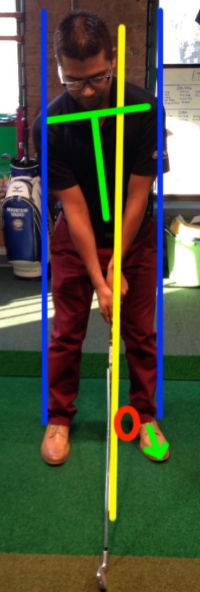
1) Red: Ball position just inside of left heel
2) Yellow: line should go from ball, through hands, then ear
3) Green: spine is tilted away from target, left shoulder is higher than right, left foot is flared toward target
4) Blue: balanced between left and right side
Practice for short periods of time (10 minutes) a couple times a week throughout the winter. This will give you a solid chance of making clean contact in the spring.

Setting Winter Golf Goals
Learning how to properly set golf goals for winter will ensure improvement during the off season.
As the golf season approaches the winter months, now is the perfect time to reflect on your past season. Did you make progress with your game? What areas of your game still need improvement? Give yourself an honest assessment and write down a specific, realistic and measurable goal for the off season.
To reach your goal we need to start with a plan. Answer the following four questions in order to kick start your focus and motivation.
1) What do I want to accomplish with my golf game? Make sure it is specific, realistic, measurable and has a deadline. Example: I want to break 90 by the end of next season.
2) What's currently happening with my game? Be honest and objective. What have you tried to improve and what were the results? Think about current obstacles holding you back. Is your goal still realistic? Example: I'm currently shooting in the high 90's/low 100's. I play once a week, but rarely practice. My driver constantly slices to the right, and my short game could be better. I found some tips online that helped for a little while, but the slice came back. I'm busy and don't have much time to practice.
3) What are some options to accomplish my golfing goal? Really brainstorm and be creative. If you could do anything to make progress what might it be? Ask others you trust for their opinion. Example: I could start taking lessons and practicing. There are drills I can work on at home, and I know I can squeeze in at least one hour a week to hit balls. I could also use my cell phone to video my swing and analyze when practicing. My basement has carpet, so I can practice putting.
4) What actions do I need to take? Which of the above options can I do? How and when will I go about it? Which options interest me the most and seem fun? Example: I'm going to schedule a lesson for every Tuesday at 6pm and practice Saturday mornings. I'm going to do drills in front of a mirror for ten minutes before bed twice a week, and practice putting 6 footers in the basement once per weekend. There is also a golf dome in the suburbs I can visit once a month to work on short game. If I get into a good routine I should have improved by spring.
I'd encourage you to share your goals with me or a friend in order to have some accountability, but more importantly this exercise is to help get you energized about improvement.

The Art Of Framing
Here is a mental game tip for every golfer that will help you play better and enjoy the game.
Most golfers understand that the mental side of the game is important and has a direct impact on their performance, yet many don't know how to practice it.
Here is a simple and specific tip that will help your mental game:
“Realize you have the power to frame situations and experiences anyway you want to.”
Successful golfers tend to interpret situations in a positive light, while poor golfers focus on the negative. This is so important because positive framing preserves and builds confidence, while negative framing destroys it. Having confidence leads to motivation, joy and taking action, while negativity leads to fear, doubt and quitting.
Examples:
1) Situation: a golfer spends an hour practicing putting before his round and is making everything on the practice green. He then goes on the course and misses short putts on the first three holes.
Negative framing/poor golfer: "I don't know why I even bother to practice because it never translates to the course. What a waste of time! Looks like another poor putting day."
Positive framing/good golfer: "I know I'm a good putter even though I've missed a few short putts. It just means that I'm due to start making some. Even PGA Tour players miss short putts. I'm going to continue to stay focused and make a committed stroke."
2) Situation: a golfer goes to the range after a lesson and hits the ball worse than normal.
Negative framing/poor golfer mindset: "Well I just wasted more money on another lesson. This is the third instructor I've been to and I get the same crummy results. Maybe there is no hope for me."
Positive framing/good golfer: "I wish I would have hit the ball better today, but I understand improvement is a process. Golf is a fickle game at times, and in the end it was only one bucket of balls. I felt really tense the whole time. I'll try to relax and go slower next time."
3) Situation: a golfer is playing the round of their life only to crumble on the last hole and miss shooting their career low by a shot.
Negative framing/poor golfer mindset: "Just blew it again! Every time I'm under pressure I choke. I'll never get another chance to shoot my career low. Even if I do I'll probably just mess it up again."
Positive framing/good golfer: "I'm disappointed I didn't shoot my career low, but I'm getting closer! I realize I tend to get quick under pressure. I'll remember this next time I'm in a similar situation and keep my focus."
When framing is used correctly a golfer finds a lesson and learns from from his experiences...good or bad. They will feel energized, optimistic and excited, compared to feeling hopeless and frustrated.
Guess which golfing mindset gets better results?

Don't Let The Wheels Fall Off: Tips To Save A Round
Whenever you feel like your round is going to take a downward spiral, try these tips to helps save it.
Every golfer has days when their ball striking is giving them trouble. Here are some tips to save the day.
1) Keep it Simple: getting too mechanical on the course distracts you from focusing on the target. If you need a thought "Back, Through, Hold Your Finish" is better than working on a specific position.
2) Focus on Rhythm, Balance and being Tension Free: This can be done by monitoring your grip pressure during the round (keep it light), and holding your finish until the ball stops.
3) Play Your Game: If you're slicing the driver aim for that shape. If you're still having trouble pull out the 3 wood or long iron. It's difficult to fix the swing on the course. Instead hit a club you are confident in then work on your swing after the round.
4) Never give up: Easier said than done especially on hot and humid days, but you never know when you'll have that great swing that changes the momentum of your round and gets you back on track. Sometimes that great feeling of solid contact comes back on the last few holes and you can remember this for your next round.
5) Don't Compound Your Mistakes: Even if you're not hitting it well, don't let it affect your focus on and around the green. Minimize three putts and multiple chip shots. This definitely helps keep the score down when the swing doesn't feel right. A four foot putt counts the same as a perfect 280 yard drive on the scorecard.
6) Pick Conservative Lines/Miss in Better Spots: When there is Out of Bounds on the right and 100 yards of course on the left there is no excuse for missing right. With approach shots forget about the flag and miss on the side of the green where you'll have an easy chip and putt.
After the difficult round go to the range and focus on basic fundamentals. Often times poor alignment, set-up and ball position is the reason for the inconsistency.

How To Handle Golf Frustration
Learn basic techniques to help handle the inevitable frustrations that golf brings.
Picture this: You get to the golf course on a beautiful morning for a game with your friends. The birds are singing, the sun is shining and the grass is perfect.
Your first shot of the day flies straight and far…... into the trees out of bounds on the right. "No worries" you tell yourself and tee up another ball only to hit it 10 feet in front of you. All of a sudden you feel slightly embarrassed and smile at your friends. Inevitably bad shots start to fill the day. The driver slices in the woods and cannot be stopped, a bladed wedge over the green from 50 yards, 3 putts from 10 feet, leaving the ball in the bunker……FRUSTRATION!!!!
Golf is a unique sport because one day we can love and obsess about the game, then the next day we can feel extreme frustration and anger. It's best to realize that every golfer has and will experience peaks and valleys in the game. Here are 5 strategies to help you cope when golf is giving you trouble.
Strategy 1) Put Golf In Perspective
In the end golf is just a game. There are more serious matters going on in the world everyday and there are worse things than shooting a bad score. Appreciate the blessing in your life and that you're lucky to have the physical ability to play in the first place.
Strategy 2) Be Factual About Your Game
When you're slicing the ball to the right instead of saying "I'm horrible with my driver. I'll never be able to hit it straight", be factual. "The clubface is pointed to the right at impact, and I need to check my grip and alignment". If your'e having trouble putting and chipping don't tell yourself "I have a bad short game, I'm not any good with my wedges", be factual. "I haven't spent any time practicing that part of my game, and that's why I'm having trouble". Having a golf coach helps clear up any confusion about your game and will present you with simple solutions to your faults.
Strategy 3) Be Your Best Friend
Unlike baseball, basketball or football, golf is not a team sport. You only have yourself to rely on. Dig deep and tell yourself encouraging statements like "You can do it!", "You've hit great shots with this club, let's do it again!", etc. . You'll have a better chance to picking yourself up and getting your game going. The alternative? Being negative and throwing in the towel. Never give up on yourself.
Strategy 4) Be Neutral or Positive
When you have a strong negative reaction to a shot it gets stored deep in the memory. This memory will later come up when you're playing golf in a similar situation. Put the bad shots behind you and really appreciate the good shots. Next time you hit a great shot, close your eyes and store that amazing feeling into your memory for later use.
Strategy 5) Pay Attention to What You're Telling Yourself
There is constant self talk in your head during a round of golf. Telling yourself negative stories about your game will lead to negative beliefs about your abilities and destroy the possibility of confidence. Don't let this happen! Instead be present in the moment. Look around and take in the details of the course or be social with your playing partners. The mind is powerful so make sure it's working for you rather than against.
The sooner you can put the poor shots in the past, the faster you'll be on your way to better golf. Many of my students just need a simple reminder of basic fundamentals to get them hitting the ball better again. There is no perfecting golf so enjoy the journey of improvement.
“Whether you think you can, or you think you can’t—you’re right.”― Henry Ford”

The Truth About Golf Lessons
There comes a point in every golfers journey where improvement plateaus, but the desire to get better stays strong. Learn about the process of taking golf lessons.
There comes a point in every golfers journey where improvement plateaus, but the desire to get better stays strong. Your buddies advice isn't producing the magic it once did, the Golf Digest articles are now becoming confusing, and watching the Golf Channel isn't curing the slice. It's time for a golf lesson! This article is for anybody currently learning golf or considering getting lessons.
Golfers have options when it comes to lessons; one-on-one with an instructor, group clinics, day long golf schools or online guidence. All are great options, but I want to go into detail about private one-one one lessons. This is the way I learned the game, the way I teach the majority of my lessons and the approach of many of the best players in the world. There is no substitute for hands on instruction and undivided attention. A relationship will form and improvement will happen faster. It's also comforting for a golfer to know they have a specific coach to go to for anything golf related.
The Improvement Process
Lasting improvement in golf happens incrementally, over an extended period of time with proper practice and play. This does not mean a player can't have a great lesson and leave hitting the ball better than ever, but to truly become a consistently skillful player under pressure requires focus to the process. It's the same as learning a musical instrument or become physically fit. The easy part is knowing what to do, but its the level of commitment that makes the difference."The Secret is in the dirt" Ben Hogan famously said, basically meaning never give up, never stop trying to get better. A productive mindset to have before taking lessons is having the goal of improving a little bit everyday, every week, every month and each season. When you look back at your progress after a year, you'll see huge improvements in your game.
Every Golfer is Unique
Next, each golfer is unique with their goals. I need to know exactly what fuels my clients passion and find a goal that is measurable, realistic and attainable for them to strive for. Unveiling the true potential of my students and making them realize they will get better if they work smart is a great feeling. Also, knowing that we desire the same outcome creates instant focus from the start. Golfers also have their own specific limitations (physical, time, etc.) that may limit their progress. It's important for me to understand these limitations and come up with a custom plan for each client. If the golfer has desire and work ethic to improve, a quality instructor will get them better.
Custom Game Plan
So depending on the goals of each client, I like to make a plan on what to work on first. Usually the goal is improving ball flight with a certain a club; such as minimizing a slice with a driver. I would watch you hit several shots while recording video and observe tendencies and patterns with the swing. We would then sit down together and discuss the reasons why the ball slices and come up with options on how to fix it. It's important to find the root cause of the problem that way the player only works on one or two things at a time. Often its a review of basic fundamentals such as grip, posture and alignment. Other times its more complicated like how the body is pivoting or what starts the downswing. I'll then demonstrate and show specific drills to improve the fault. We would start with slower swings to feel the change, and hit many balls as I provide feedback. Finally I provide a plan on how to practice in between lessons and how much time to devote to working on the swing vs. hitting shots to a target.
It's now the players responsibility to practice. My students that make the most progress get into a routine of practice, play and lessons. Eventually the slice becomes better, then we focus on other parts of the game to make the golfer well rounded. Once a goal is reached it important to make another one. Always strive to get better. This is why we see tour players take lessons for years with a coach. After many lessons together, the coach learns your tendencies and personality, is better able to convey information and encouragement and knows which drills/swing thoughts work and which ones don't. It then becomes very fast for the coach to help the player because they intimately know the player and their swing.
Fix Yourself
Finally it's important for the student to become their own best coach. Knowing that my students can understand, feel and fix their swings truly provides satisfaction. It means their focus can be on playing the game, hitting specific and unique shots to a target, adjusting to weather, and performing under pressure. This is what makes golf so much fun, and why I provide lessons in the first place.
If you're serious about getting better at golf, find a qualified PGA Professional for assistance. They will greatly reduce the amount of frustration and wasted time that often happens when trying to learn the game on your own.

How to Practice Productively
Make sure the time you devote toward improvement is being used efficiently. Learn to practice like the pros!
There is nothing more frustrating than dedicating hours of your valuable time to hit countless golf balls at the range only to play horrible on the actual course. This scenario is very common and makes a golfer question whether than can actually get better or not. The truth is that golfers DO get better when they know HOW to practice correctly. Quality definitely outweighs quantity when it comes to golf practice. Here are the basics for making your next practice session effective.
1) Go To The Range With A Plan
Start by asking yourself what you want to accomplish from your practice session. It often helps to assess your current golf game and find the weakness that is preventing you from playing your best. Commit that practice session to focusing purely on that weakness. Many golfers often hit their favorite club over and over because they have confidence with it. Check the ego at the door and practice that part of the game that makes your feel uncomfortable.
2) Split Practice Time
Now that you've identified the weakness in your game that you want to work on, you need to split practice between technique, games and simulated play.
Technique- has to deal with the mechanics of the swing. Hopefully you've had a lesson and understand what needs to fixed. Focus on changing elements of the swing through exaggeration, drills and slow motion movement. Where the ball goes does not matter when working on technique. Focus on body and club movement rather than ball flight. Also use feedback such as mirrors, video or training aids. DO NOT make the mistake of spending your whole practice session with a technique mindset.
Games- playing specific games on the range makes a player target oriented and introduces pressure to the scenario. Examples are: how many balls can you hit out of 10 on the green from 100 yards?, how many solid shots can you hit in a row while keeping balance? Can you curve a ball to the left with one shot, then to the right with the next one? Can you hit it high, medium or low with the same club? Etc… Once you've played these games a benchmark has been set, then you try to beat it. Have fun and get creative with games. The mindset with games should be about executing shots, rather than making a technically sound swing.
*Add image 3-2
Simulated Play- Time to bring the course to the range! Playing good golf is about putting quality shots together with different clubs. Play a pretend 9 holes on the range by choosing random targets and hitting .
Hole # 1: Hit driver, 7 iron, pitch shot, chip shot. Hole #2: Hit 4 iron, chip shot Hole #3: Hit driver, 3 wood, pitching wedge….Make this experience as realistic as possible. Use the same pre-shot routine you would on the course, take a longer time between shots, hit from clean and poor lies, etc. Be aware if your tempo, tension or balance changes as your playing.
3) Keep Track of Progress
After an effective practice session it's important to take notes about the session. It can be as simple as writing down the swing thoughts you had when you were hitting the ball well, or keeping scores for the games you played on the range. You will eventually have a journal of your practice accomplishments and will see measurable progress.
This should give you a better idea of how to spend your time practicing and provide basic structure. I'd also recommend consulting with a PGA Professional to provide a custom practice plan for your goals. They will provide clarity with the technique portion of practice, as well as give you several ideas for games. When done correctly practice becomes fun due to variety and and the internal competition with yourself to get better. You'll be practicing all parts of your game and be a well rounded golfer when it's time to play on the course.

Essential Skills to Play Great on the Course
Learn Essential Playing Skills that apply to golfers of all levels and has nothing to do with technique.
I recently went to the PGA Teaching and Coaching Summit and had a chance to gain some valuable insights from the most respected golf instructors in the world. One of the classes was titled Peak Performance Practice For Skill Development presented by Lynn Marriott and Pia Nilsson.
They worked closed with Annika Sorenston as well as recent PGA Tour Winner and Chicago native Kevin Streelman.
They focus on developing Essential Playing Skills in their students so they can play their best while on the course and provide tangible ways to practice.
Essential Playing Skills
- Play Box: Executing shots in an athletic performance state and being present through your senses.
- Decision and Commitment: Having the courage to commit to a simple and clear decision for every shot
- Balance: Having a good sense of balance improves the swing and stroke
- Tempo: Having an intimate sense of tempo helps the body and swing be in sync for the day.
- Tension Awareness: Tension kills the golf swing so it's best to be aware and monitor tension levels.
- Emotional Resilience: Being able to go to your happy place allows you access to your whole brain.
- Storage of Memory: Events that get emotionalized get stored deeper in the brain. Being happy or neutral in you post-shot routine is desirable.
- Self-Talk: Make sure to be your best friend and coach when playing. You're the only one out there, so talk to yourself in a productive way.
Every golfer knows the importance of the mental game but rarely does anything to practice it. We now have ways to practice the mental game through Vision54! Lynn and Pia have an iPhone app that gives specific drills to work on the above skills. As an instructor it's important that my clients not only have solid fundamentals with their swing, but are well rounded golfers that can execute on the course. These skills are what all good players have in common and cannot be practiced enough.