

The Mindset Shift That Lowers Golf Scores

Most golfer's think better golf comes from more confidence and better swings.
In reality it comes from better decisions and faster acceptance.
Here are 4 mental shifts I see that separate golfers who score well from those who stay stuck:
Acceptance Is a Skill: Golf is a game of misses. The players who score aren’t the ones who avoid bad shots—they’re the ones who don’t fight them. Acceptance doesn’t mean you like the result. It means you don’t let one swing steal the next one.
Redefine Success During the Round
If success only equals good shots, frustration is inevitable.
Instead, judge your round by:
• Did I stick to my routine?
• Did I commit to decisions?
• Did I respond well emotionally?You can play poorly and still play well mentally.
Your Pre-Shot Routine is Your Anchor: A simple routine creates clarity under pressure: 1.Think 2.Choose 3.Commit 4.Swing
Once you step in, thinking is over. Trust the decision and let it go.Choose Commitment Over Confidence: Confidence comes and goes. Commitment is a choice. A fully committed swing with doubt beats a hesitant swing every time.
Good golf isn’t about controlling outcomes. It's about making good decisions, accepting faster, and committing fully. That's the real mental game.
Here are 3 Free Audiobooks by Bob Rotella (famous golf psychologist) you can find on YouTube to improve your mental game. I recommend listening before bed or on your way to the golf course.

Golf Gratitude in 2026
Before you set your 2026 golf goals…

As we head into 2026, it’s natural to set swing and scoring goals—but there’s a perspective I don’t want you to miss.
In Extraordinary Golf by Fred Shoemaker, an older golfer reflects on the game he can no longer play. His regret wasn’t poor scores—it was waiting his entire golf life to feel good enough to enjoy it.
He realized too late that he had spent thousands of hours:
Obsessing over his swing instead of noticing the beauty of the course.
Frustrated with his score instead of connecting with friends.
Denying himself joy while waiting for a perfection that never came.
This is what I want you to remember:
Don’t wait to enjoy the game.
There is no perfecting golf.
You don’t get unlimited rounds.
Our 2026 Mission: Play an Enriched Game
This year, I challenge you to focus on two things:
1. Relentless Gratitude
Take 10 seconds during each hole to look up and notice where you are.
Appreciate the walk, the grass, the trees, and the fact that you have a body that allows you to play.
The “older you” would give anything for one more round—don’t waste it.
2. Be the Best Playing Partner in your Group
Encourage more than you critique
Laugh more than you judge
Help your partner find their golf ball
Be fun & play fast!
People won’t remember your score, but they’ll remember how you made them feel.
We’ll still work hard on your swing and your strategy—that doesn’t change.
But let’s make sure that years from now, you can say you didn’t just play the game… you truly lived it.
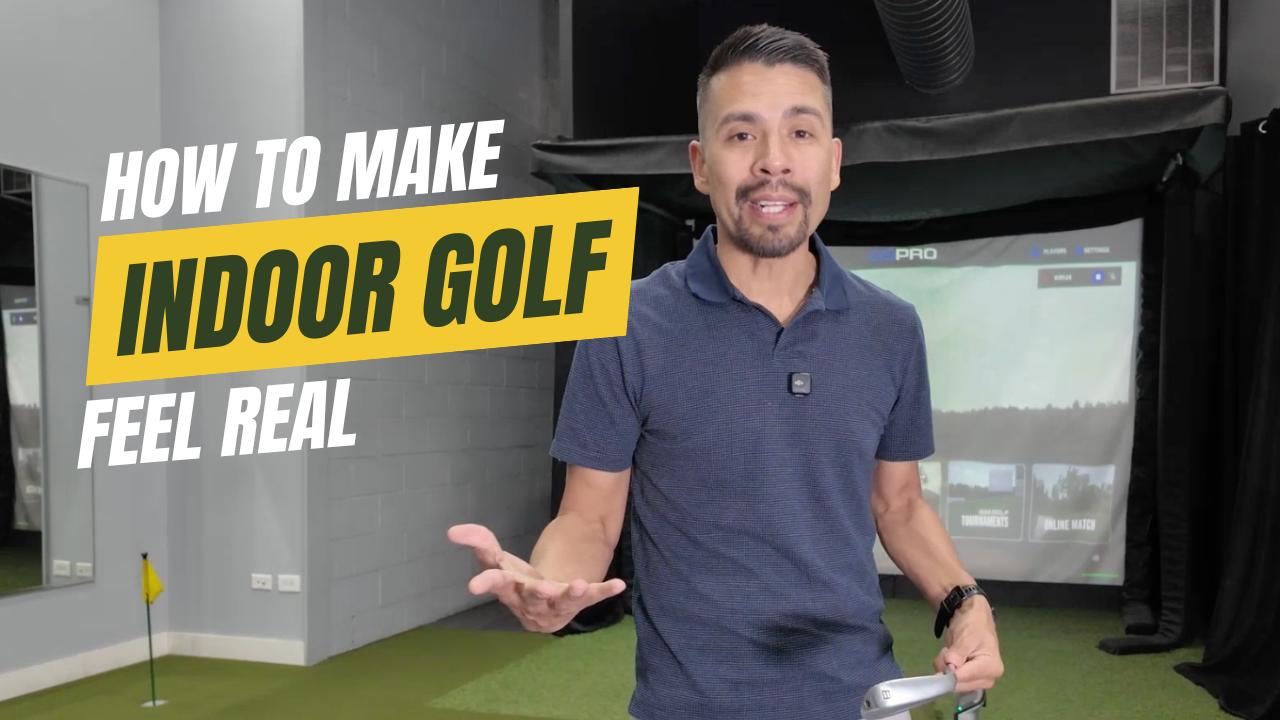
How To Make Indoor Golf Feel Real
In this video, we break down how to move beyond "block practice" and make your indoor simulator sessions actually translate to the golf course.
Using GSPro software, we show you how to set up a dynamic challenge that forces you to adapt to new yardages and scenarios on every swing.
What You’ll Learn: Avoid the Block Practice Trap: Why hitting the same club repeatedly can stall your progress.
Try this 9-hole challenge and share your score in the comments below! Subscribe to My Chicago Golf for more tips on mastering the game.
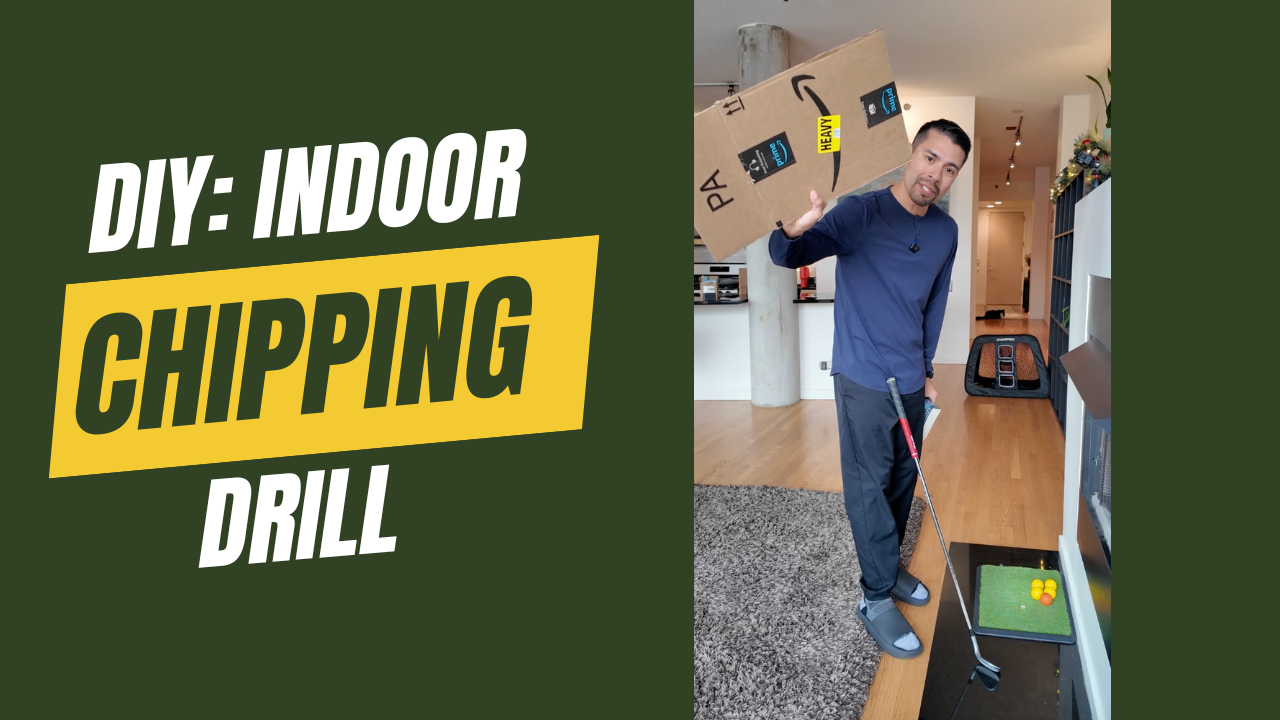
DIY: Indoor Chipping Drill
Too cold to hit the course? 🥶 Don’t let your short game freeze up this winter! In this video, I show you how to build a simple DIY Indoor Chipping Station using items you probably already have at home.
This "Cardboard Box Drill" is perfect for developing your golf hands and ensuring you hit down on the ball rather than scooping it.
What You Need:
• Small golf mat (12x18)
• A piece of cardboard (an Amazon box works great!)
• Foam golf balls (safe for indoors)
• A chipping net
The Drill:
Place the cardboard box directly behind your mat.
The goal is to chip the ball into the net without hitting the box on your backswing or downswing.
• Setup: Weight forward, ball back in your stance.
• The Swing: Keep your nose in front of the ball and finish with your clubhead low to the ground.
• The Feedback: If you hit the box, you’re likely tilting back or scooping! Start at 3 steps away and work your way back as you improve.
Use this off-season to dial in your contact so you're ready for the first tee time of spring! Subscribe to MyChicagoGolf for more tips to improve your game!
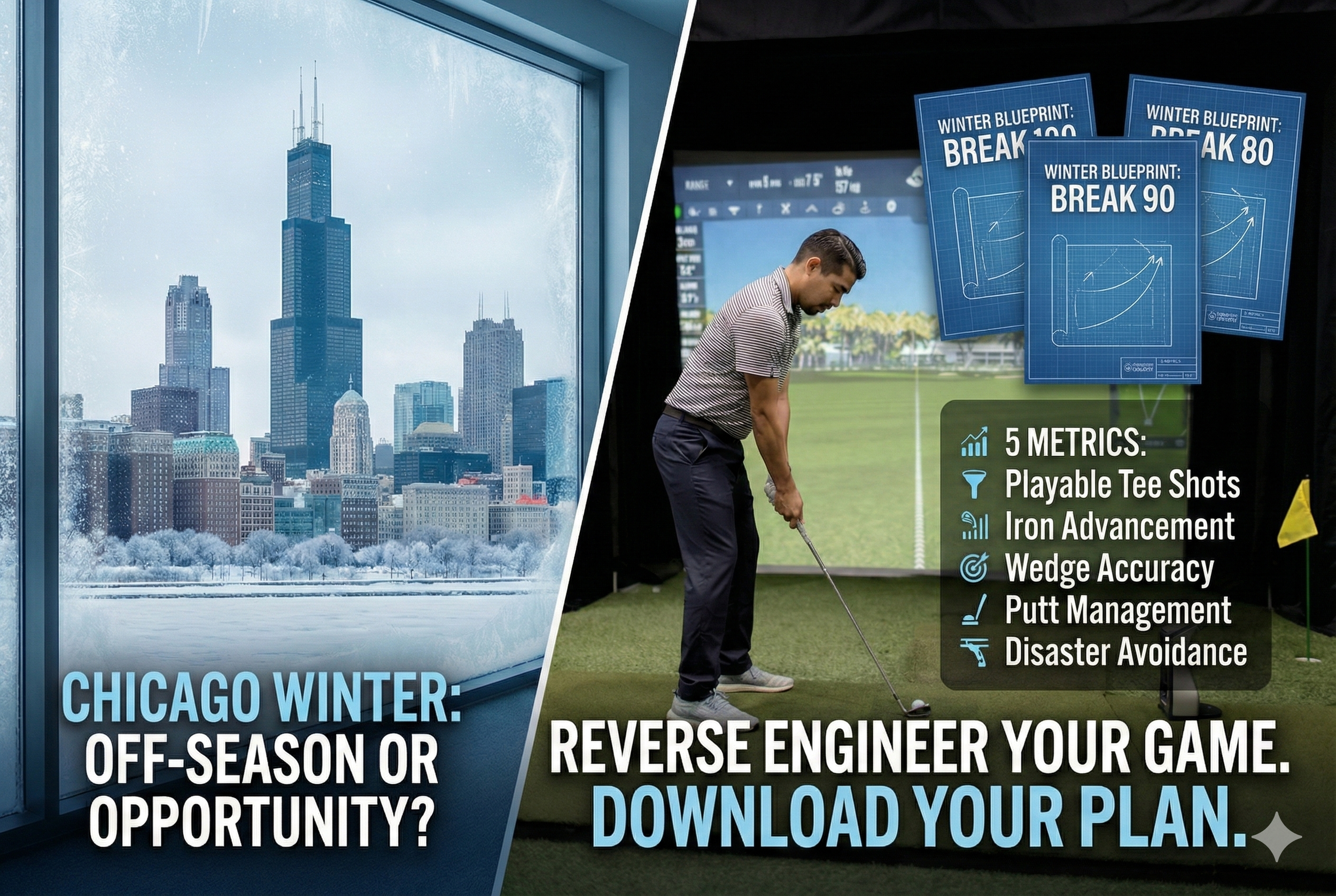
Winter Golf Practice Plans
Download our specific 'Winter Blueprint' training plans to master the five metrics that actually lower your scores.
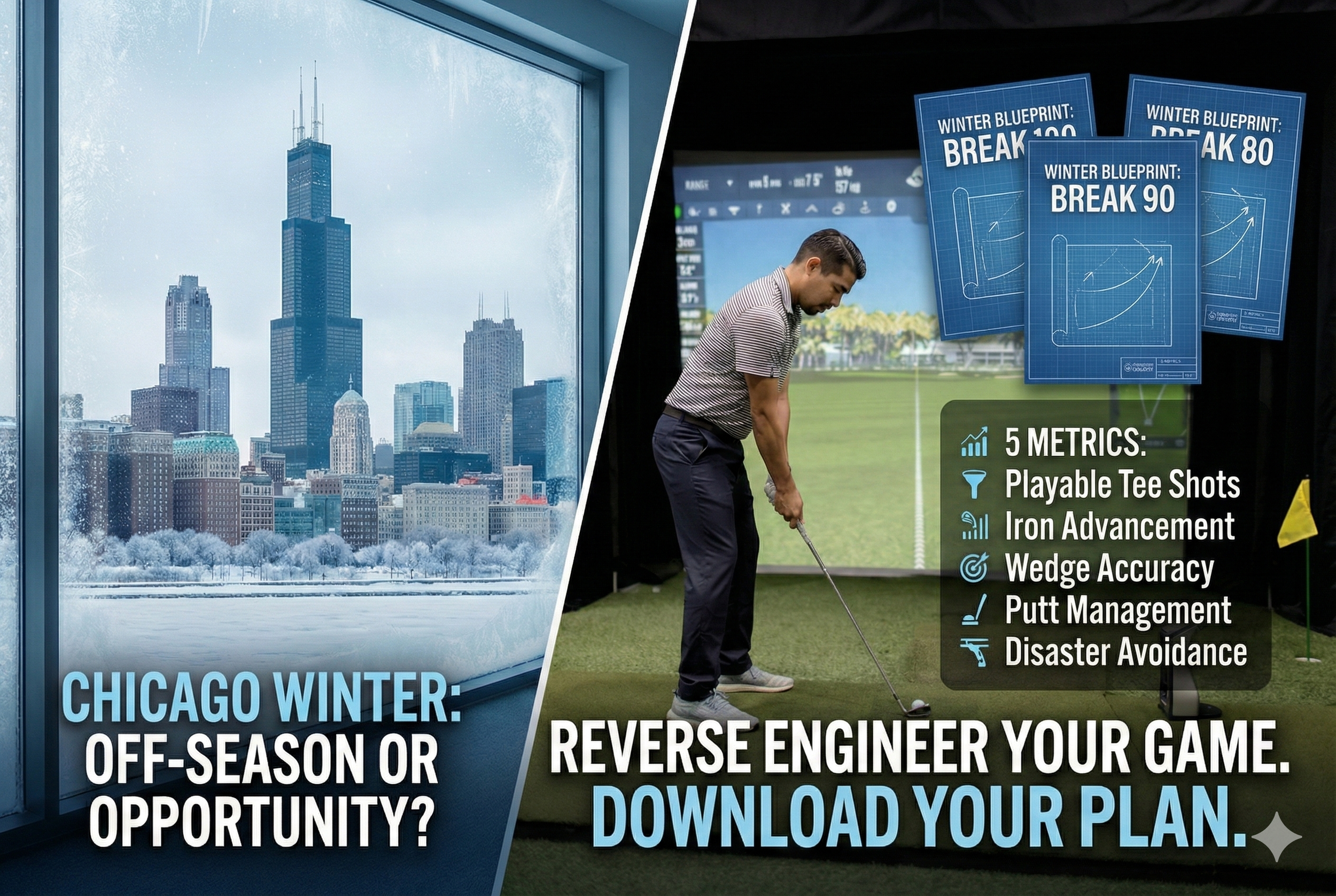
We have a choice this December. We can let the clubs collect dust until the Masters, or we can use the next 4 months to completely transform your game.
Champions are made in the off-season.
While others let their swings rust, we are going to Reverse Engineer yours. No aimless ball-beating in the simulator. We are connecting your Outcome (The Score) directly to your Process (The Work).
The 5 Metrics That Actually Lower Scores: To hit your number, you don't need miracles. You just need to master these skills:
Playable Tee Shots: Chase "findable," not just far.
Iron Advancement: Clean Contact. Move the ball forward.
Wedge Accuracy: Get on the green. No "two-chips."
Putt Management: Speed control is king. No 3-putts.
Disaster Avoidance: Eliminate the penalties that wrest scorecards.
Your Winter Battle Plans: I've created three printable PDFs to guide your indoor training. Download the one that matches your goal:
Download "Winter Blueprint: Break 100"
Download "Winter Blueprint: Break 90"
Download "Winter Blueprint: Break 80"
The Challenge: Print your plan. Put it in your bag. When you go to the simulator, follow the roadmap.
If you commit to the work now, you won't be shaking off rust in April.
Let's get to work!

Simplify The Golf Swing
If you’re feeling lost or confused with your golf swing, try this basic framework…
Goal: Simplify the golf swing by breaking it down into a manageable "hip high to hip high" motion where the body’s pivot acts as the main engine.
Key Fundamentals & Tips:
Feedback Station: Create a channel with two alignment sticks to keep the path straight and use a ramp (pad) behind the ball to ensure the club moves "up" rather than flattening out.
On-Plane Checkpoint: When looking in a mirror from the side, the club shaft should appear to pass through your right forearm during the backswing.
Square Face: During the takeaway, the club face should point down towards the ball line, avoiding any excessive rolling or twisting of the hands.
Pivot and Point: On the follow-through, shift weight to the front foot and turn your belt buckle to the target, finishing with the club pointing at the target.
Recommended Drills:
Toe Line Check: Place a driver on your toe line. Practice bringing the club back parallel to the ground so the shaft hovers directly over the driver on the ground.
Towel Drill: Tuck a towel under both arms while making small swings to learn how to keep the arms connected to the body's rotation.
Hip-High Swings: Start with a pitching wedge and make small swings focusing on the "up the ramp, thump, and pivot" feeling before adding speed or length.

Stopping Hitting Ground Before The Ball
Here’s some tips to help eliminate hitting the ground before the golf ball…
Goal: Stop hitting "fat" shots (hitting the ground before the ball) and instead achieve ball-first contact where the divot occurs in front of the ball.
Key Fundamentals & Tips:
Setup & Balance: Ensure the handle isn't too low (club at waist height) and maintain balance. Position the ball neutral to slightly forward with a little weight on the lead foot.
Body Movement: A successful swing requires both shifting weight and rotating the body. Doing only one often leads to hitting the ground early.
Avoid Swaying: In the backswing, stay within the frame of your feet and keep your arms connected to your body rather than letting them drift independently.
Preferred Miss: It is better to err on the side of hitting the ball slightly thin (low on the face) rather than hitting the ground first, as this still advances the ball.
Recommended Drills:
The "Swoosh" Drill: Swing a knotted towel or club upside down and focus on hearing the "swoosh" sound on the target side of the ball, which indicates proper rotation and speed at the right moment.
Chair or Wall Drill: Stand a hand-width away from a chair or wall. Practice shifting and rotating until your belt buckle faces the target and your knees touch, ensuring you clear your hips without sliding.
Obstacle Drills: Place a tee 1-2 inches in front of the ball and try to hit it, or place a towel a few inches behind the ball to force yourself to avoid hitting the ground early.

Total Game Golf Skills Challenge
Try this 11-Golf Shot Skills Challenge next time you’re at My Chicago Golf.


New Golfers Love Operation 36
The best way to learn how to play golf is from the green to the tee. Start small, then grow the swing.
One of our favorite ways to get new golfers into the game is having them play Operation 36.
The main idea is to learn how to play golf from the green to the tee. Starting with smaller swings and shorter distances, then advancing your way to big swings and longer holes.
The goal is to shoot 36 for 9 holes, meaning each hole is a Par 4.
Level 1 = 25 yard holes
Level 2 = 50 yard holes
Level 3 = 100 yard holes
Level 4 = 150 yard holes
Then 50 yard intervals all the way to Level 10 = 450 yards.
Here's a video showing how Operation 36 works:

5 Tips To Build Your Golf Confidence
Here are 5 tips to help you feel confident for your next round or upcoming golf trip.

The Most Important Shot in Golf
It's debatable which shot is the most important in golf….I think it’s the Driver!..
It's debatable which shot is the most important in golf.
Some say it's the putter because it counts for 40% of our score. "Drive for show, putt for dough."
Some think it's the next shot, because we should focus on the present and not past or future shots.
Here's a hot take: I think it's the Driver!
When you hit a good drive, it makes the rest of the game easier. When the driver isn't working, it can completely ruin your round.
Here's 5 steps to help you with the big stick:
Step 1: Visualize how the driver should properly impact the ball. The clubhead should move shallow/smooth towards the target, with a square clubface, while hitting the tee.
Step 2. Create a feedback station for the proper movement of the club. Place an alignment stick 2" outside the ball. Then place a head cover on the stick behind the ball. Lastly place a tee 3' in front of the ball as an intermediate target.
Step 3: Setup for Success: The driver has a similar posture to an iron from the side, but from the front, it has more spine tilt, a wider stance, and a forward ball position.
Step 4: A low/wide one-piece takeaway is a commonality amongst good drivers of the ball. Your shoulders/core will be the engine of this movement which creates coil.
Step 5: Allow your lower body & belt buckle to start the downswing. This will pull you to a balanced finish. Avoid trying to hit the ball with your shoulders and arms.
Metrics to look for when training on a simulator:
Impact Point: middle of face to slightly north of center
Launch Angle: between 12-16 degrees
Spin Rate: between 1500-2500 rpms

How To Take Your Golf Game Outdoors
Many of you have worked hard on your game in a simulator this winter, now it’s time to take it outdoors…
Tip 1: Go to the driving range and calibrate your alignment. Aim the clubface to the target, then aim your body to the club.
Tip 2: At the range, hit your first few shots off a short tee. Practice clipping the tee with the club to feel solid contact, then remove the tee and hit off the grass.
Tip 3: Focus more on the target than swing. Create a simple pre-shot routine that promotes commitment and athleticism to the target.
Tip 4: Be forgiving of your mistakes. Allow your body to adapt to the different environment. Many golfers start to feel comfortable in 2-3 rounds. Take note of your tendencies to help guide your practice.

Start Your Golf Season With Clean Fundamentals
In this video, Marcus Yado PGA, will discuss some tasks and checkpoints you can do to ensure you start your golf season with clean fundamentals…
In this video, Marcus Yado PGA, will discuss some tasks and checkpoints you can do to ensure you start your golf season with clean fundamentals. This will help you make solid contact on the course guide your practice at the range and give you a couple mental keys to think while playing.

How To Make Your Golf Swing Flow
Flow in the golf swing is how you sequence the shifting and turning of your body during the swing….
Flow in the golf swing is how you sequence the shifting and turning of your body during the swing.
When done correctly it leads to:
1. More power and distance
2. Pure contact
3. Consistent timing
Try these 3 drills to incorporate flow into your golf swing.

Come Play Augusta National (Home of The Masters)
We recently upgraded our golf simulator software at My Chicago Golf. Here’s a sneak peak of Augusta National GC, home of the Masters on our simulators. Watch as a I play Amen Corner!
We recently upgraded our golf simulator software at My Chicago Golf. Here’s a sneak peak of Augusta National GC, home of the Masters on our simulators. Watch as a I play Amen Corner!

What To Do At The Driving Range
Use this training routine next time you to to the driving range: 1. Create a training station 2. Start with small swing focused on contact 3. Then focus on controlling clubface (direction) 4. Start with Pitching Wedge, then use every other club 5. Switch over to “Play Mode” by changing targets and using pre-shot routine
Use this training routine next time you to to the driving range:
1. Create a training station
2. Start with small swing focused on contact
3. Then focus on controlling clubface (direction)
4. Start with Pitching Wedge, then use every other club
5. Switch over to “Play Mode” by changing targets and using pre-shot routine

3 Keys For Golf Consistency
Every golfer wants to be more consistent with their golf games and ball striking. Here are 3 keys to help you be more consistent on the golf course…
Every golfer wants to be more consistent with their golf games and ball striking. Here are 3 keys to help you be more consistent on the golf course.
1. Tension Awareness
2. Rhythm & Tempo
3. Balance
And drills to help you improve these skills!

Hit The Ball Farther: Avoid This 5 Distance Killing Mistakes
Golf is more fun when you’re making solid contact with the ball and hitting it max distance…
Golf is more fun when you’re making solid contact with the ball and hitting it max distance. In order to make it happen you’ll want to avoid these 5 common mistakes:
Not hitting the center of club
Having an excessively open or closed face
Having a poor body pivot
Not swinging towards target
Not properly sequencing your downswing
Bonus Tip: Play fitted equipment

How To Practice On A Golf Simulator
Learn how to improve your golf game on a simulator by using this simple practice plan…
Learn how to improve your golf game on a simulator by using this simple practice plan:
Warm Up The Body
15 Ball Wedge Work
Learn Your Distances
Test Your Proximities
Test Your Tee Shots
Post A Score
On-Course Scenarios
Common Simulator Mistakes
Feel free to download our Golf Simulator Training Guide PDF